Meghalaya’s GeoAI platform demonstrates how AI can move from data and pilots to evidence-based decisions on school access, learning outcomes and resource allocation
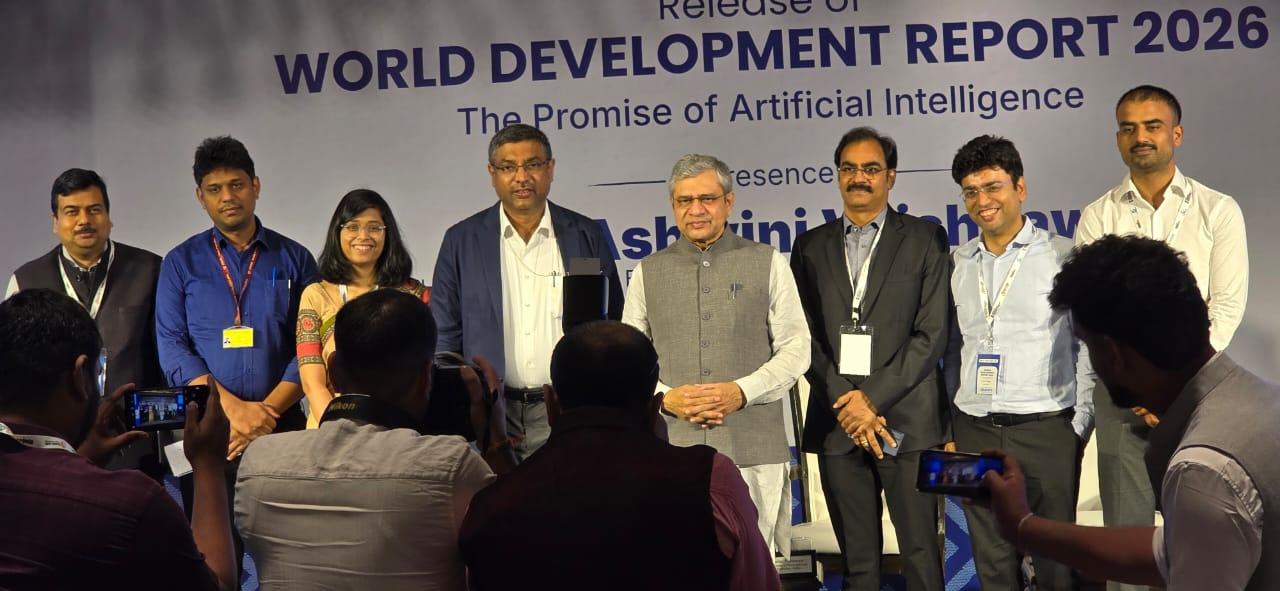
New Delhi | October 9, 2026: As India and the global development community focus on moving Artificial Intelligence from experimentation to measurable development outcomes, edGrid, a GeoAI-powered education governance intelligence solution developed by Deepspatial, was showcased today as one of the select State AI innovations at the India launch of the World Bank Group’s World Development Report 2026: The Promise of Artificial Intelligence.
The India launch was organised jointly by the IndiaAI Mission, Ministry of Electronics and Information Technology (MeitY), Government of India, and the World Bank Group, bringing together senior policymakers, development experts, technology leaders and practitioners to examine how AI can be adopted, adapted and scaled to address real-world development challenges.
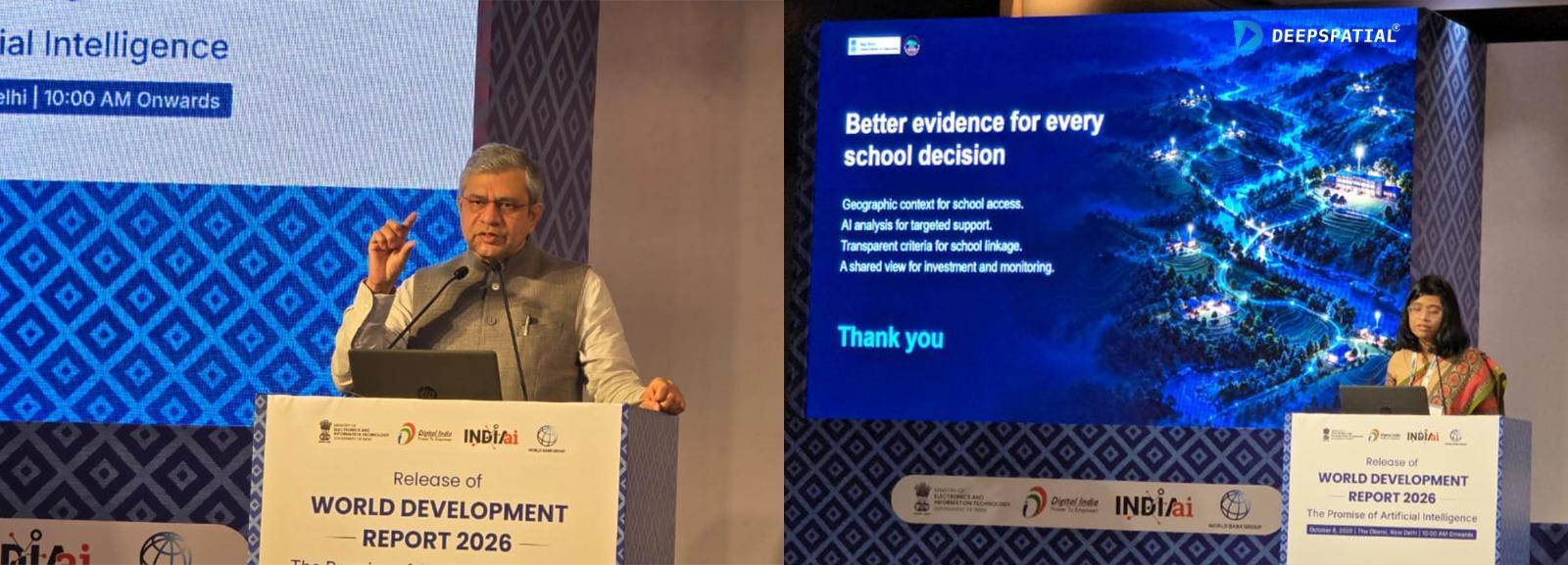
The event was inaugurated by Shri Ashwini Vaishnaw, Union Minister for Electronics and Information Technology, Railways, and Information and Broadcasting, who formally launched the Report.
The State AI Showcase - “AI Innovations from Across India” brought together solutions demonstrating how Artificial Intelligence is already being applied to address complex challenges across health, agriculture, education and other areas of public interest.
Representing Meghalaya, Ms. Richa Kulkarni, IAS, State Project Director, Samagra Shiksha Abhiyan and Director, School Education & Literacy, Meghalaya, presented edGrid - GeoAI & Governance Intelligence for Education, developed by Deepspatial.
From AI pilots to decisions that reach the ground
The presentation of edGrid demonstrated a fundamental shift in the way education systems can use AI, not simply to generate more data, but to connect data, geography and outcomes to the decisions that governments have to make every day.
In Meghalaya, education planning has to contend with difficult terrain, scattered habitations, varying accessibility and fragmented information across multiple systems. The edGrid approach brings these dimensions together into a common spatial intelligence layer.
The platform geo-codes schools, villages and road networks and layers them with demographic, socio-economic, infrastructure, health and academic information, enabling administrators to see the education system in its geographic and community context.
At the heart of the platform is a simple governance proposition:
Data in. Intelligence out. Decisions on the ground.
edGrid brings together school records, MIS, attendance and finance data, census and village demographics, roads and terrain, health and nutrition information and stakeholder surveys. Its GeoAI engine then applies spatial analysis, machine learning and predictive techniques to convert these disparate inputs into actionable intelligence.
The resulting intelligence supports the complete governance cycle, from assessment and analysis to prediction, prescription and monitoring.
Richa Kulkarni: “The real value of AI is in helping us make better decisions”
Speaking at the State AI Showcase, Ms. Richa Kulkarni,IAS, State Project Director, Samagra Shiksha Abhiyan and Director, School Education & Literacy, Meghalaya, said:
“The real value of AI in education governance is not simply in generating more data, but in helping us make better decisions from the data we already have. In Meghalaya, geography is a critical part of the education story. edGrid helps us bring school, community, accessibility, infrastructure and outcome-related information into one spatial view, enabling us to identify gaps and prioritise interventions based on evidence. It is an important step towards making education planning more contextual, responsive and data-driven.”
Her presentation demonstrated how the platform can help answer four fundamental governance questions: Where is access limited? Which schools need support? Which school linkages are viable? And where should resources be prioritised?
Making geography visible in education planning
For Meghalaya, location is not simply a map attribute, it can determine whether a child can realistically reach a school.
edGrid uses road-network distance, travel time, terrain and physical barriers to provide a more realistic understanding of school accessibility than straight-line distance alone. Its spatial intelligence can identify underserved villages and communities and help administrators understand the relationship between schools and the populations they serve.
The platform's School Linkage capability further supports evidence-based school rationalisation by assessing potential feeder-receiver relationships against factors including enrolment viability, distance and accessibility, receiving-school capacity and teacher availability. The approach is aligned with the school-complex framework envisaged under NEP 2020.
This creates a fundamentally different approach to planning, one that moves beyond asking where a school is located to understanding who it serves, who is being left out, what is driving outcomes and where the next intervention can have the greatest value.
“What makes edGrid valuable from an implementation perspective is that it helps translate data into a decision pathway. Instead of looking at school information, accessibility, infrastructure and community indicators separately, we can bring them together spatially and ask a much more important question, where is the need greatest and what intervention can make the most difference? That can significantly strengthen evidence-based planning and resource prioritisation.”
Dany Lyngdoh, Principal Consultant at PMU, Department of Education, Govt of Meghalaya
From the school map to the learner
The presentation also demonstrated how spatial governance intelligence can sit alongside learning intelligence.
The broader education technology ecosystem showcased through Meghalaya included gamified assessments and personalised adaptive learning, demonstrating how student-level evidence can complement system-level governance intelligence.
This creates the possibility of connecting two traditionally separate views of education: what is happening inside the classroom and what is happening around the school.
At the system level, edGrid's intelligence modules include geodemographic profiling, school information and analysis, school accessibility, village gaps and accessibility, education impact analysis, gap analysis, academic performance prediction, school intervention, spending efficiency, predictive survey research, education and health, school linkage, 3D mapping and governance intelligence.
A live governance platform, not another data system
A defining feature of edGrid is that it is designed to integrate with existing government systems rather than replace them.
The platform draws upon existing MIS, attendance, learning management and finance systems and adds a spatial and intelligence layer that allows decision-makers to analyse information in context.
The platform's current Meghalaya architecture includes 14 intelligence modules, with the edGrid dashboard covering 12,042 schools, 1,160 villages and 555 school and village variables in the platform's current assessment framework.
Its development journey has moved from a GeoAI-in-Education research approach and statewide study to district-level spatial intelligence, a live governance dashboard and intelligence modules, with a pathway towards wider deployment across Meghalaya.

Deepspatial: turning spatial data into decision intelligence
For Deepspatial, the showcase represents a broader opportunity to demonstrate how GeoAI can become an intelligence layer for complex governance systems.
Dr. Bushra Zaman, Chief AI Officer, Deepspatial, said:
“AI becomes transformative when it moves beyond prediction and becomes part of the decision-making process. edGrid demonstrates that shift. By bringing geography, education data, infrastructure, community context and learning indicators together, we can help decision-makers move from fragmented information to a much clearer understanding of where the need is, what is driving it and where intervention should be prioritised.”
She added:
“What we are demonstrating through edGrid is not simply an education technology solution. It is a model for how GeoAI can create an intelligence layer for governance, one that can help institutions understand complexity, prioritise scarce resources and continuously learn from what is happening on the ground.”
An example of AI for development
The showcase of edGrid closely reflected one of the central themes of the World Development Report 2026: that the development opportunity from AI lies not only in creating sophisticated models, but in adapting and deploying AI effectively within local contexts, institutions and systems.
At the India launch, speakers emphasised the importance of moving beyond isolated AI pilots towards evidence-based scale-up, supported by local capabilities, relevant data, appropriate institutional frameworks and solutions designed around real development needs.
edGrid offers a practical illustration of that approach.
It begins with a very real governance challenge, how to plan education for thousands of schools and communities across complex geographies and uses AI, machine learning and geospatial intelligence to turn fragmented information into a decision-support framework.
The platform's impact framework identifies decisions ranging from where to open or upgrade schools, which schools to link, where teachers should be deployed, which schools require support, which budget heads should be prioritised and where health convergence may be required
From Meghalaya to a scalable model
The edGrid journey is designed around a progression from district to state to multi-state scale, using a replicable architecture that can work with existing government data and processes.
Its significance therefore extends beyond the education sector.
The same GeoAI principle, understand the geography, integrate the data, identify the gaps, predict the need and prioritise action, can be applied to complex public-sector challenges across health, agriculture, infrastructure, disaster management and other development domains.
The showcase at the World Bank Group's India launch of the World Development Report 2026: The Promise of Artificial Intelligence puts edGrid within a larger national and global conversation: how AI can move from promising technology to practical intelligence that improves the way institutions make decisions and deliver outcomes.