

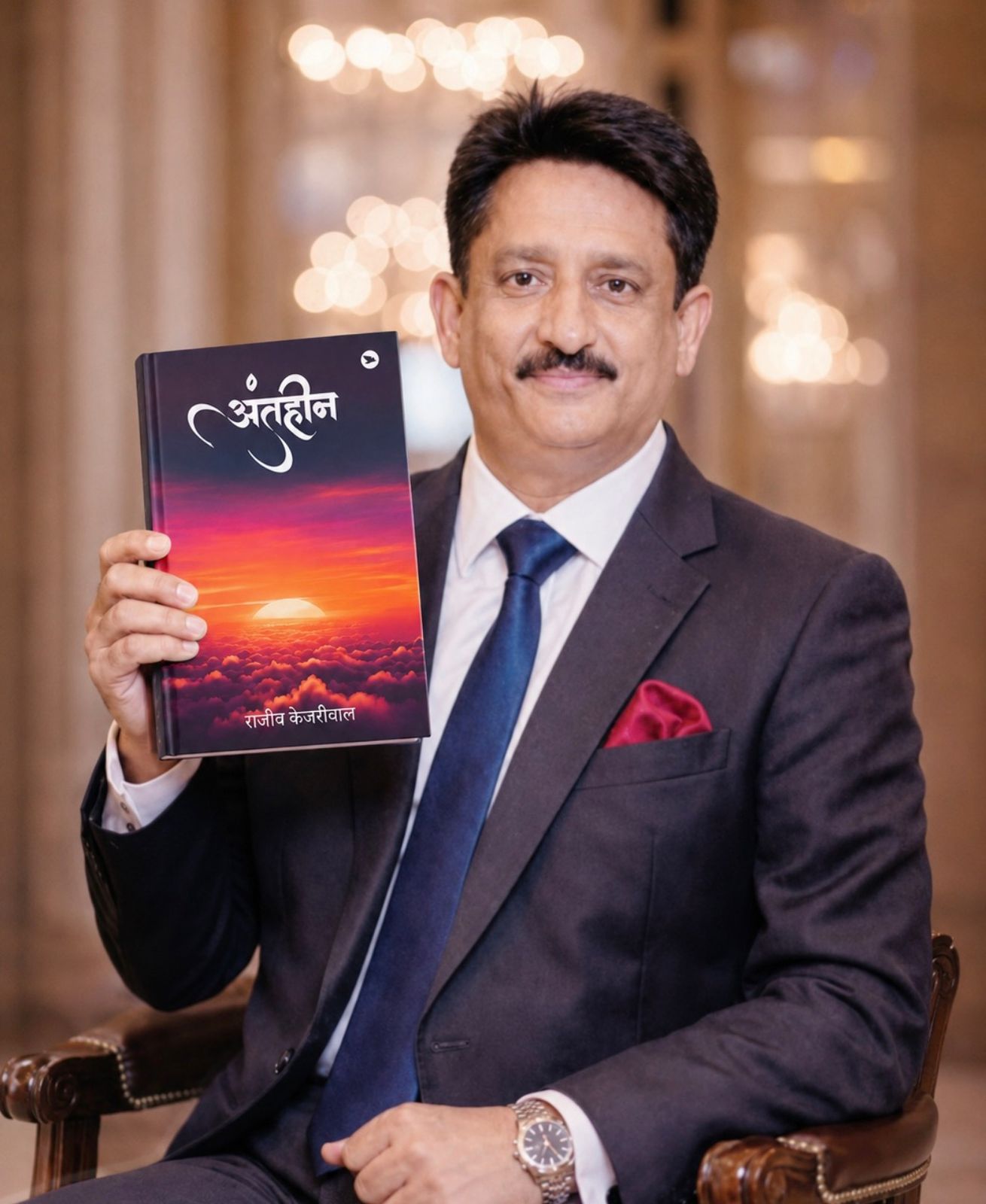
In an age where poetry often gravitates either toward intellectual abstraction or social provocation, Rajeev Kejriwal occupies a distinctly personal yet surprisingly expansive space. A bilingual author with multiple published works to his credit, Kejriwal writes from the intersection of lived experience, memory, relationships, philosophy, humour and observation. His poetry emerges not from literary experimentation alone, but from a sustained engagement with life itself.
What immediately distinguishes Kejriwal’s body of work is its remarkable thematic range. Within the same corpus one encounters poems on love and longing, aging and mortality, friendship and family, grandchildren and childhood, environmental concerns, social commentary, spirituality, humour, festivals, national identity, and the quiet anxieties of modern existence. Yet despite this diversity, a consistent voice runs through his writing: a voice that remains deeply human, accessible and emotionally sincere.
Perhaps Kejriwal’s greatest strength lies in his ability to locate poetry within ordinary experience. He does not require grand events or dramatic settings to create emotional resonance. A fleeting memory, a family gathering, an old friendship, a festival, a passing thought, or the absence of a loved one become occasions for reflection. His poems often begin with deceptively simple observations before unfolding into deeper meditations on time, relationships and the human condition.
A recurring motif throughout his work is the passage of time. Few contemporary poets return so persistently to questions of age, memory and personal evolution. Whether writing about childhood, middle age, or the responsibilities that accompany maturity, Kejriwal approaches time not merely as a chronological force but as an emotional landscape. His poems repeatedly ask what is gained and lost as life progresses, and whether the child within ever truly disappears.
His love poems are notable for their emotional restraint and maturity. Rather than relying on overt romanticism, they explore longing, distance, remembrance, companionship and acceptance. Similarly, his poems on grief and remembrance avoid melodrama, finding strength instead in recollection and gratitude. The departed are rarely mourned as abstract figures; they are remembered through gestures, habits, conversations and everyday details that keep them alive within memory.
Another noteworthy aspect of Kejriwal’s poetry is its conversational quality. He writes in a language that invites readers rather than intimidates them. His verses often carry the cadence of spoken reflection, allowing readers from diverse backgrounds to connect with the emotions they contain. This accessibility should not be mistaken for simplicity; beneath the familiar vocabulary often lies a thoughtful engagement with identity, duty, purpose and self-discovery.
Equally compelling is his capacity for humour and self-irony. Many poets excel in either seriousness or wit; Kejriwal comfortably inhabits both. His lighter poems reveal an observant mind capable of finding profound truths hidden within everyday absurdities. Even in moments of laughter, one senses the presence of reflection.
Taken together, Rajeev Kejriwal’s work represents a rare blend of emotional authenticity, thematic versatility and human warmth. He writes neither from an ivory tower nor from a position of literary detachment. Instead, he writes as an attentive participant in life; someone who continues to observe, question, remember and feel deeply.
In the final assessment, Rajeev Kejriwal’s poetry is best understood as a long conversation with time, memory and the human heart. His distinctive achievement lies not merely in the breadth of subjects he explores, but in his ability to transform everyday experience into meaningful reflection. In doing so, he has created a body of work that is intimate without being narrow, philosophical without being obscure, and deeply personal while remaining universally relatable. Such qualities ensure that his voice occupies a distinctive and increasingly significant place in contemporary Hindi literature.
